Champagne supernova, planetary discs and a new moon
- Dec 31, 2025
- 7 min read
Updated: Mar 4
In honour of the new year, I shall celebrate with a brief recap of some exquisite astronomy including supernovae, growing stars, planetary discs and... the 2025 reunion of the best band on the planet (Champagne Supernova is one of the most famous songs by Oasis), here is a little post to celebrate another full circle around the Sun!
A new moon!
Rather excitingly, a new object was discovered right on our doorstep in the solar system! The mighty infrared/optical Webb telescope discovered a new moon orbiting Uranus, as seen in the image below. The moon, named S/2025 U1, joins 28 other known moons of this planet, 13 of which are captured in this image. Keen Shakespearean scholars will note many of these names appear in some of his most famous plays- Puck the spirit in A Midsummer Night's Dream, the tragic Ophelia in Hamlet, the romantic Juliet (and to a lesser extent, fair Rosalind) in Romeo & Juliet, as well Desdemona from Othello and Miranda in The Tempest. This image is in fact a composite formed with three different treatments of data, which allows viewers to see the planet's atmosphere, surrounding rings and orbiting moons all at once, despite the drastic differences in brightness.

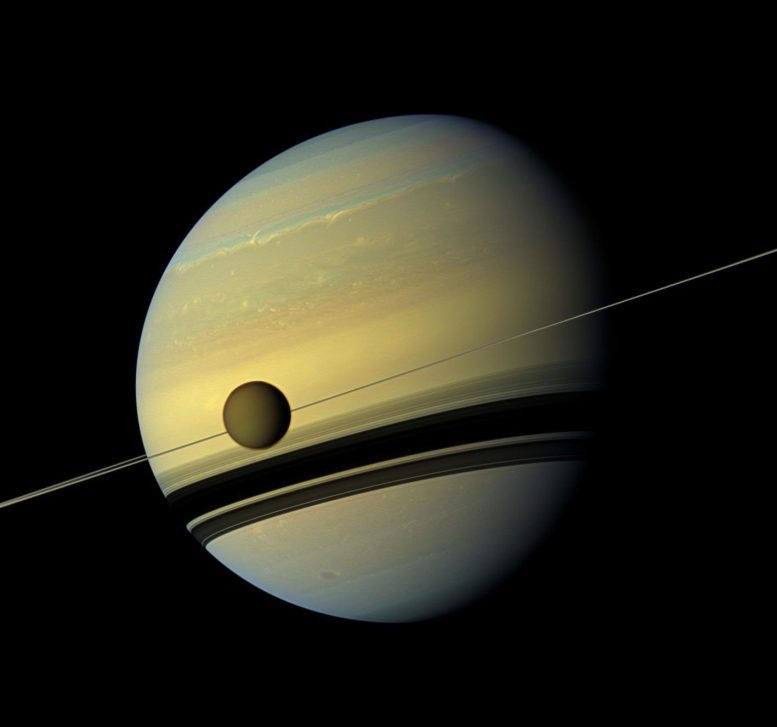
The most famous planet with rings is Saturn, whose rings have puzzled astronomers ever since they were discovered by Galileo in the 1600s. Through his telescope, it appeared that Saturn had blurry ears on each side. We now know there are 7 rings around the planet (sadly I don't think this was the inspiration of Ariana Grande's 7 rings hit song of 2019), and these are mainly composed of water ice and icy rocks. While very wide spanning hundreds of thousands of kilometres, the rings are surprisingly thin, about the height of a two storey building, meaning they can seem to disappear when observed edge on. There is some debate as to how long they have been around; some astronomers estimate they are a mere 10% of the age of Saturn (400 million years compared to Saturn's 4.5 billion), meaning they have not been around long in cosmic terms, and could disappear again in a few hundred million years. Beyond the rings, a collection of moons orbit Saturn, including my absolute favourite, Enceladus, with its icy plumes, subsurface ocean and potential hydrothermal vents hosting microbes, which you can read more about here.
Planetary discs
Beyond our Solar System now, this Hubble image shows the largest planet-forming disc ever observed around a young star. Spanning 640 billion km (around 40x wider than our Solar System), this dusty disc is a turbulent environment around a young star, surrounded by a chaotic mix of dust, gas and wispy material where planets could eventually form. The image resembles a burger, where the patty shows a dark strip of dust obscuring the host star, and the buns on either side show glowing, white dust clouds reflecting starlight. Studies such as these provide a unique opportunity to study planet formation in extreme conditions and turbulent environments.

Staying with the theme of discs, the ALMA observatory this year detected signs of multiple complex organic compounds in the protoplanetary disc of the young protostar V883 Orionis. Such compounds are exciting as they are considered to be the precursors to building blocks of life as we know it, such as sugars and amino acids, something I learnt about in my interdisciplinary masters degree at Cambridge last year. Potentially, this could suggest that protoplanetary discs inherit (and further develop) these complex molecules from earlier evolutionary stages, meaning that these seeds of life are assembled in interstellar space. It is a very exciting time to be involved in astronomy on the cutting edge of physics, chemistry and biology combined. There are multiple theories as to how life emerged on Earth, including comets delivering life sustaining molecules from elsewhere, and potentially this discovery could add credence to this theory. However, I find it somewhat unsatisfactory, as it merely pushes the question as to where the seeds of life came from further back. I explored other theories, such as alkaline lakes and hydrothermal vents in this previous post. The image directly below is an artist's impression of the disc surrounding a young star, with a zoomed in picture of the molecules within it.

It often bugged me in magazines or books that it wasn't always clear what was a real image and what was drawn, how big were these things and what were the colours what we could actually see. So, in honour of that baffled and sometimes irritated child, here is a real telescopic observation (courtesy of the JWST) showing the protoplanetary disc around a star called Fomalhaut. Since it was taken with an infrared filter, we would not be able to see this protoplanetary disc with our eyes since this wavelength of light is beyond the human visible range. For an approximate scale, see the bar in the bottom left, which is equivalent to 80AU (where 1 AU is the Earth to Sun distance). Possibly, the rings and gaps are caused by orbiting planets going around the host star, which you can read more about here.

Star formation galore
This astronomical blog post would not be complete without a traditional picture of a good old exquisite stellar nursery with growing stars! Another Webb snapshot, this one scratches beyond the surface of a star forming region known as the Cat's Paw Nebula (or NGC 6334), which is 4000 light years away and inside our Milky Way galaxy. Another infrared image, it shows previously unseen detailed features of the young stars carving away at nearby gas and dust, sculpting the surroundings with intense winds and radiation. The nebulous glow is caused by the light shining from massive young stars. This scene is but a temporary snapshot, as these disruptive young stars have relatively short lifespans yet play a very important role in their region's history, really living up to the spirit of burn bright, live fast, die young. I at least aspire to the first two of those.

Champagne Supernova (in the sky)
The earliest supernova to date has been spotted by, once again, the multi-purpose and highly dependable Webb telescope. A bright flash from a gamma ray burst was detected earlier this year by a different telescope, so Webb was wheeled in for further investigation (obviously it wasn't actually on wheels, it's a telescope in space rather a long way away). A gamma ray burst is the most powerful and bright class of explosion that exists in the universe, releasing intense bursts of highly energetic gamma rays that can last from milliseconds to several hours, caused by dramatic events such as the collapse of massive stars. The supernova is thought to have occurred when the universe was just 730 million (0.73 billion) years old, a small fraction of the universe's estimated 13 billion year age, and a new record for Webb. For those who aren't aware- Champagne Supernova is one of the most iconic songs by the band Oasis, and you've almost definitely heard it even if you hadn't heard of the title. Now go and listen to it.

Hello (it's good to be back)
And back on planet Earth, it has been a phenomenal year for Oasis and their loyal fans (myself included), who were treated to a grand world tour spanning 41 electrifying performances for the first time since 2009 whent the band split. I saw Noel, the senior of the two Gallagher brothers, performing in Leeds in 2023 and had a fabulous time with a fellow physicist. Unbeknownst to us all, a few months later the Oasis reunion concerts were announced, almost 30 years after their debut album Definitely Maybe was released, and it felt like an exciting moment in cultural history. Watching clips from the concerts, it is moving to see multiple generations of people from all ages, some of whom were so young they must've been born after Oasis originally split, coming together to sing some of the most iconic songs of modern time. I have watched some of their shows and interviews from the 90s, and wished I could've been born a decade or two earlier so I could've lived through the glory heydays of the era. Naturally I and many other young people see this era we never lived through with rose tinted lenses- a time which predated smartphones, social media and a lot of the geopolitical uncertainty we see today, and a time when money seemed to go further, people were happier and more carefree, and ambition was in the air. Oasis captured a unique snapshot in time in British cultural history, winning over the hearts of fans all around the world with their bold, unashamedly ambitious yet fun and hilarious, even outrageous, character. Oasis songs have been on my car speakers almost every day this year, and I had arguably my favourite upbeat songs Morning Glory and Hello accompanying me in my head as I swam my leg of the England-France channel relay race this summer. Incidentally, it was a glorious morning as the sunlight glittered on the green waves, and it is a great tune to get out of bed to in the morning when you need a bit of oomph. As for the latter song, it was their opener on the comeback tour. Hello Oasis, it's good to have you back!



Comments