Distant moons, underwater worlds?
- Aug 23, 2024
- 7 min read
Updated: Aug 28, 2024
Astrophysics and swimming are my twin passions, and interestingly they come together rather neatly in the area of distant moons with potential underwater life. Given that I will soon be starting my masters in the subject of my dreams at the university of my dreams (astrophysics specialising in 'Planetary Science and Life in the Universe' at the University of Cambridge), now seems a good time to dig a little deeper into an a fascinating area of planets I've read about in passing but never in detail. Hopefully by the end of my course I will be a little more knowledgable in this area, but in the meantime, here is a simple introduction.
Firstly, Earth is not the only planet with a moon, in fact Saturn and Jupiter boast 146 and 95 moons each, and my favourites are among those orbiting these gas giants in our solar system. It seems only fair to do two moons from each planet.
Europa
This is one of Jupiter's most famous moons, and is covered in a thick, icy crust and there is strong evidence to suggest a salty ocean exists beneath. It is a similar size to Earth's moon, and orbits Jupiter once every 3.5 Earth days. Some estimates suggest Europa's subsurface ocean could hold twice as much water as all the Earth's oceans combined. It is primarily made of silicate rock with a watery ice crust and most likley an iron/nickel core. Cracks streak its surface, but it has relatively few craters, as can be seen on the zoomed in image below. Europa's surface is varied, sometimes flat and sometimes full of ridges, formed by cracks opening and closing repeatedly. These can be thousands of miles long, and a few hundred metres tall, and may change shape if they melt and refreeze. An abundance of liquid water and the right combination of chemical elements make Europa arguably the best place in the solar system to look for current life outside Earth. Furthermore, it has a very thin oxygen atmosphere, though it is too thin for humans to be able to breathe.
Europa was one of Jupiter's moons observed by Galileo in the 1600s, where he concluded that the Earth was not in fact the centre of the universe with everything orbiting us, since he could clearly see an object orbiting another planet. This got him in a trouble with the Church at the time, who believed that God had made Earth the centre of the universe. Nevertheless, Galileo was proven correct and his discovery paved the way for the acceptance of the heliocentric model, where planets orbit the Sun, in comparison to the geocentric model, where all celestial objects were thought to orbit Earth which was previously preferred. Not only is Europa historically significant, it is also a fascinating object in its own right.


Image credits: NASA/JPL-Caltech/SETI Institute - the images above have been colour enhanced, to highlight geological features and the varying chemical compositions of the surface. Cream coloured areas are made of relatively pure water ice, while the redder areas contain more impurities such as salts.
Europa has been deemed so cool that NASA has dedicated an entire mission to studying this object in more detail. This year, NASA's Europa Clipper spacecraft will be launched into space where it will begin the long journey to Europa, where it will help scientists investigate whether this moon has suitable conditions to support life.
In particular, the Clipper mission's three main science objectives are as follow:
Determine the thickness of the moon's icy shell and its surface interactions with the ocean below
investigate the moon's composition
characterise the moon's geology
Not only will this provide a more complete picture for properties of Europa, but also the astrobiological potential of habitable worlds elsewhere. My course next year will be interdisciplinary, ranging between astrobiology, astrochemistry and of course astrophysics. The physics element of astronomy is the oldest, however chemistry is playing a growing role in studying the composition and behaviour of moons and planets, while biology is important to understand the potential for life elsewhere. I'm looking forward to learning about the latest science using cutting edge techniques and keeping up with the updates on Europa as they progress over the next few years.
Io
It's not all icy crusts and mysterious oceans though, as shown by Io, another one of Jupiter's moons. This moon is the most volcanically active object in our solar system. The surface varies between magma lakes as smooth as glass, and violent erupting volcanoes, some of which have been caught in action by NASA's Juno spacecraft mission. Comets and asteroids reshape the surface further and leave behind large craters. Io is also a similar size to Earth's moon, in fact slightly larger. It orbits Jupiter even faster than Europa does, completing an orbit in a mere 1.8 Earth days.
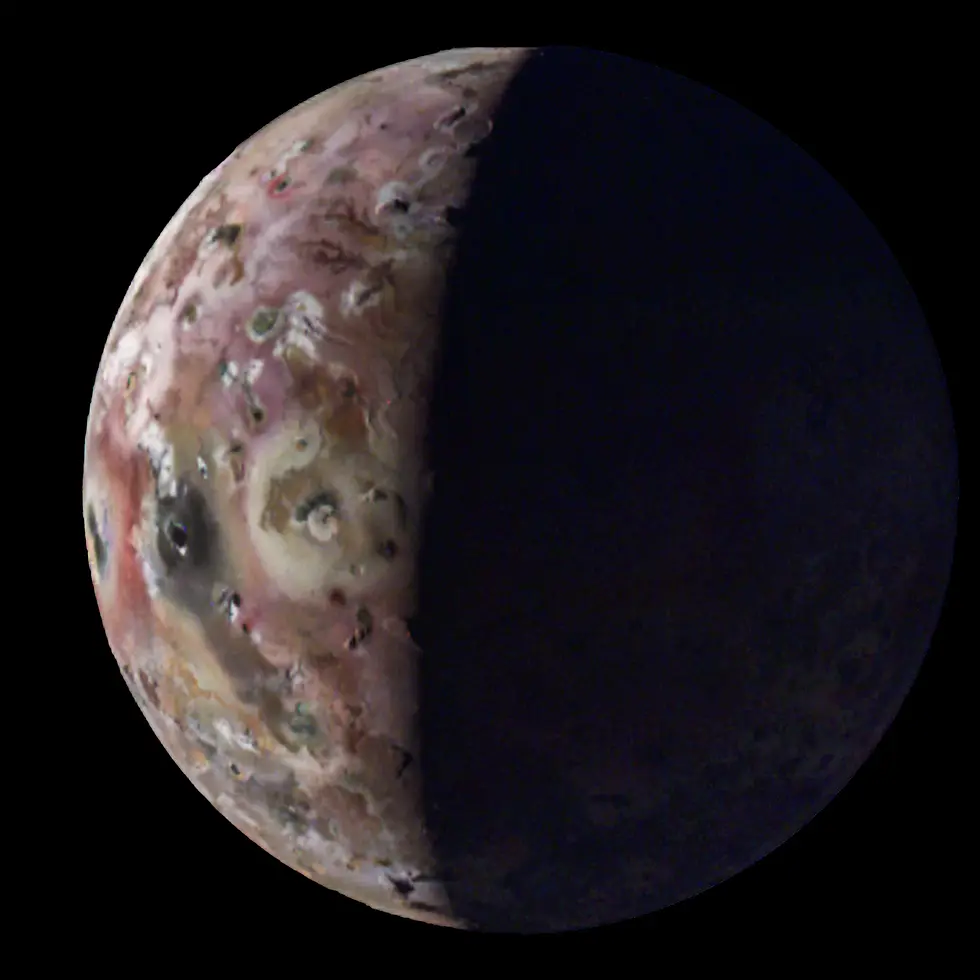
Hundreds of volcanoes spew vast quantities of ash into Io's fiery skies, which is thick with sulphur dioxide (I believe that's the really smelly one we were told not to mess around with in school chemistry lessons because it absolutely reeked). The volcanoes are the result of a gravitational tug of war between Io's host planet Jupiter, and nearby moons Europa and Ganymede. As the moons move around eachother, Io's molten interior is stretched and squashed, creating tension in Io's molten interior. While this moon almost certainly could not support life as we know it, that's not to say it could support an as yet unknown type of life. On a slightly related note, I have been listening to Rory Stewart's The Long History of Ignorance on BBC Sounds, where he interviews various scientists who repeatedly hammer home the message of how little we really know about life in the universe, and just because something does not fit our scientific model given our current knowledge does not mean it doesn't exist, although it may be harder to discover if we don't even know what we're looking for exactly. In more philosophical terms, we do not know what we don't know. Perhaps some obscure life lurks out of sight on Io after all.
Titan
Saturn is the next planet out from Jupiter, and Titan is its largest moon. This icy world is entirely obscured by a thick hazy atmosphere which blocks our view of its surface. Its internal structure is still a matter for further investigation, however it is thought to contain a silicate rocky core, surrounded by a shell of pressurised icy water, a layer of salty liquid water, and a crust of watery ice. The surface is caked in organic molecules, the origin of which isn't certain, which form sands and liquids. Through investigations of Titan's atmosphere, scientists suggest it may be older than Saturn, having formed from the same cold disk of gas and dust the Sun originally formed from, rather than in the warmer disk of material from which Saturn was later formed.

Image credit: NASA/JPL-Caltech/Space Science Institute by the Cassini-Huygens mission
There are some striking similarities between Earth and this moon. Firstly, Titan's atmosphere is mainy comprised of nitrogen, much like our own, and contains some methane. Secondly, it is the only moon in the solar system with a dense atmosphere and the only body besides Earth to have standing bodies of liquid, in this case methane, with lakes and seas across its surface. Furthermore, it is the sole other body in our solar system known to have an earth-like weather cycle of liquids raining down from clouds and flowing across its surface forming lakes and seas, then evaporating into the atmosphere again. Owing to its position relatively far out in the solar system, sunlight is about 100 times fainter on Titan than on Earth, and as such temperatures here are around -180 degrees Celcius. It is possible that Titan has some volcanic activity, but unlike Io, the 'lava' is formed from liquid water rather than magma. Scars from craters are scarce on Titan, which suggests that somehow the evidence for these are erased over time, most likely by flowing liquid smoothing the surface over time. Tectonic, the movement of surfaces due to pressure from beneath, may also play a role here. Overall, this is an underrated gem of the solar system with a surprising amount in common to the little blue dot we call home.
Enceladus

And finally, my favourite of them all. Enceladus, another of Saturn's moons, has been in the astronomy news columns a lot recently because traces of elements required for the building blocks of life have been found through plumes erupting through its surface. Phosphorus, the rarest of six elements required for life as we know it, which helps maintain cell membranes and form DNA, has been found in one such plume. The other five elements required for life as we know it; carbon, hydrogen, nitrogen, sulphur and oxygen, have already been found on Enceladus, which makes the discovery of the final piece of the puzzle all the more exciting. Cracks in the frozen surface of Enceladus allow liquid from underneath to spray through in jets, which can be sampled by spacecraft flying through them. These beautiful plumes are filled with water vapour, carbon dioxide, methane and ammonia from the ocean below the crust, and erupt at over a 1000km/h to generate a fine halo of icy dust around the moon. This is extremely handy because the chemical composition of otherwise unreachable deep oceans can be analysed in detail. At a mere 500km in diameter, this moon is about a third of the distance between the two furthest points of the UK.
While Saturn is famous for having rings around it, Enceladus creates one of its own, caused by the spray of its icy particles spreading out as it orbits its host planet. This is thought to be the source of one of Saturn's rings. Only a small fraction of the icy particles and gas spurted out of the moon's surface end up in Saturn's ring however, with the majority falling down back on to the moon's surface in a snow-like blanket.
This mosaic was created with images captured by NASA's Cassini spacecraft in 2008, after the spacecraft came within 25 km of the moon's surface. This moon's snowy surface, which looks something like the Arctic and the wrinkled texture of Papier Mâché, covers an underwater world which may yet harbour extraordinary secrets.


Comments