Hubble telescope favourite snaps
- May 8, 2024
- 5 min read
Updated: Jul 11, 2024
The Hubble telescope, launched in the 1990s, is a groundbreaking infrared and optical telescope that has provided the world with some of the most famous and beautiful astrophysical images ever taken. Its life has spanned decades and despite technical challenges when it was first launched into space, it has far exceeded its original lifespan and purpose, and here I’ll walk you through some of my favourite Hubble snaps and the science behind them.
A bumpy start
The Hubble telescope was launched into space with much fanfare in 1990, but quickly became a headache for NASA/ESA and the astronomy community when it returned blurry images as a result of a highly sensitive mirror being polished into the wrong shape. Thankfully the original plan had always been for the telescope to have service missions, and in 1993 engineers were sent into space to fix the issue, which was essentially done by placing “spectacles” over the bent mirror, optical components with the same error but in the opposite direction, thereby cancelling out the original fault. The images that followed were exquisite.
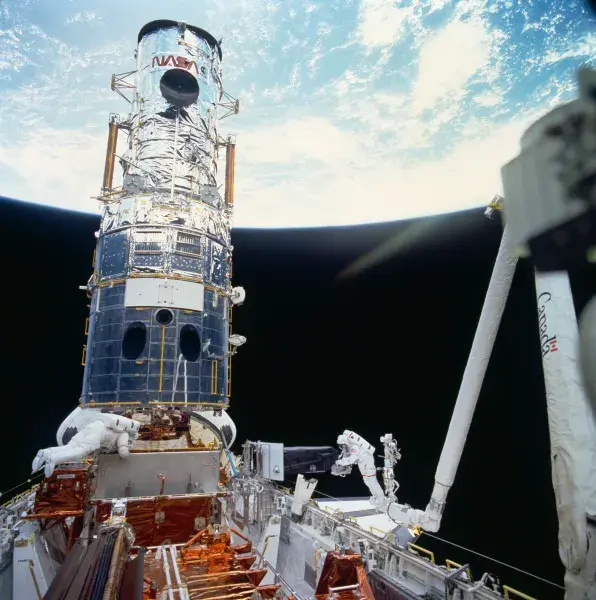
Astronauts F. Musgrave, left, and J. Hoffman fixing Hubble on the first NASA maintenance mission in 1993. In the background, Earth is visible.

Hubble’s images of the galaxy M1000, before (left) and after (right) fixing the fault caused by the bent mirror, resulting in significantly sharper images.
Credit: NASA/Hubble History Archive
All the following photos are taken from Hubble Heritage’s top 100 photos archive, of which I’ve chosen my favourites.
All images credited to: NASA, ESA, Hubble Heritage Team https://hubblesite.org/images/hubble-heritage
Jupiter - a planet and a moon - 2021
The 5th planet out from the Sun, Jupiter is our closest gas giant in our solar system. Just about visible in the left side is icy Europa, one of Jupiter’s many moons, of which there are believed to be almost a hundred.
Convection, the flow of less dense, warmer gas upwards and falling of more dense, cooler gas downwards, is behind some of the beautiful patterns seen on Jupiter’s atmosphere. The light coloured bands (zones) are the areas of warm rising gas, which soar high into the atmosphere and contain reflective ammonia crystals, while the dark coloured regions (belts) show where cool gas is sinking, making the dark hydrocarbon layer below more visible. That’s why most photos of Jupiter such as this one, taken directly facing the equator, show the planet as mainly cream coloured while photos of the poles, appear darker. Photos such as the this one taken by the JUNO spacecraft, show Jupiter photographed near its poles.

Pillars of Creation - star birth - 2005
Perhaps the most iconic and popular Hubble image is the Eagle Nebula’s Pillars of Creation. This image was taken in visible light and shows a stellar nursery where stars begin their lives in the dense gas from which they form. The image shows beautiful clouds glowing in multiple colours from the radiation received by embedded stars, which feed off their surrounding gas. Inside the “pillars”, the dust is blasted by intense radiation from young stars embedded within the clouds and eroded by strong winds from massive nearby stars.

Crab Nebula - remnant of an exploded star - 2005
Another iconic Hubble image is the supernova (exploded star) remnant called the Crab Nebula, which is the largest ever image taken by the Hubble telescope and consists of 24 individual exposures taken by the telescope's WFPC2 camera. It is among the most studied objects in astronomy, first spotted almost a millenium ago by Chinese astronomers in 1054, who noticed a new 'guest star' in the night sky that had not previously been there, and was visible for a whole month, even in daylight. What was seen was in fact a bright stellar explosion or supernova, the remnants of which can be seen in the photo below.
While the colours assigned to the telescope's observation do not match what we would see with our eyes (the Hubble telescope measures light intensity in greyscale and the colours are added by astronomers afterwards), the colours assigned provide an insight into the composition of the star's remnants. The orange parts show its shredded remnants, mostly consisting of hydrogen, while the outer blue filaments represent neutral oxygen and the green shows ionised molecules of sulphur and oxygen. On exploding, a star ejects its matter outwards, and it is this matter, colliding with surrounding interstellar medium, that we can see. Still leftover from the star's explosion is its ultra-dense core (neutron star) which is still embedded within the centre of the nebula and ejects light beams from its poles, appearing to pulsate as the core rotates almost 30 times per second. The strange blue light in the centre is caused by radiation emitted by extremely fast electrons being accelerated to near the speed of light around the neutron star's strong magnetic field.

Whirlpool Galaxy - a spiral like our own - 2005
The sweeping arms of the spiral galaxy M51, also known as the Whirlpool Galaxy, show long strands of dusty gas and stars. The spiral arms are home to the galaxy’s younger stars, while the oldest ones reside in the yellow coloured core. In the galaxy arms, hydrogen gas is compressed and clusters of new stars are formed from the pink coloured gas, adding new inhabitants to this stellar neighbourhood. Each galaxy is home to millions or billions of stars.
A smaller galaxy, NGC 5195, is also shown drifting past the Whirlpool. The gravitational pull of the smaller galaxy has caused gravitational waves to ripple through the Whirlpool, compressing gas and triggering waves of star formation. Just as in the Pillars of Creation image above, the most massive stars eventually sweep away the dusty cocoons with blasts of radiation, intense stellar winds, and shock waves from supernova blasts. Bright blue star clusters emerge from the mayhem, illuminating the Whirlpool's arms like city streetlights.

Hubble Ultra Deep field - thousands of galaxies in the cosmos - 2003
Zooming out again, the famous Deep Field image shows nearly 10,000 galaxies, some just like the Whirlpool, where each galaxy contains millions to billions of stars. The galaxies below vary in age, size, shape and constituent stars. The reddest galaxies are the oldest at almost 12bn years old, having formed not long after the Big Bang. The larger, brighter galaxies by contrast are only (!) one or two billion years old, and have a clearer spiral or elliptical structure. So, with thousands of galaxies in this one image, each containing billions of stars, many of which will have planets orbitting around them, some of which may have life, it is just possible that somewhere in this image, we are looking at other life in the universe, possibly similar to our own, or possibly completely different. Given there are billions of galaxies, the possibilities seem almost dizzying, and gives a sense of how tiny we are in the massive universe.
Galaxies come in a variety of shapes, such as spiral, elliptical, barred or irregular, which can be due to their formation history or age. Sometimes, galaxies collide or interact with each other and consequently change shape. Images such as these help astronomers patch together a timeline of how galaxies behave at different stages of their lives. Obviously, we don't live long enough to watch them transform across their multi-billion year lives in real time, but by looking at galaxies across a range of ages, it is possible to infer their evolution, in a similar way to how walking around a forest and examining trees of different ages can help put together a rough timeine of how a tree matures throughout its life.

So there ends my whistle-stop tour of my favourite Hubble images, from nearby planmets and moons through to active star forming clouds and the galaxies in which they live! At some point I will do a follow-up post on my favourite images from the James Webb telescope, which was launched in 2021 and has already given astronomers much to scratch their heads about through a series of dazzling sharp images showing the cosmos in unprecedented detail.


Comments