Pretty pictures - an astronomer's dream
- Sep 23, 2024
- 5 min read
With two weeks to go before university term kicks off for my astrophysics masters, I'm making the most of my remaining free time by exploring some more science, and today we're back on familiar territory with astronomy! Future posts in the pipeline include maths puzzles and an investigation into satellites, but back to the pretty pictures for now!
One particularly fun website I like is NASA's APOD (Astronomy Picture of the Day) archive. Every day, a new photo is released alongside a little description written by a knowledgeable scientist, I particularly recommend finding the photo released on your birthday. I have collected my favourites over the years, in order from the centre of our Solar System outwards.
Sun photobombed by Venus

Ultraviolet Sun and Venus.
Credit: NASA/SDO & the AIA, EVE, and HMI teams; Digital Composition: Peter L. Dove
At the centre of our Solar System lies the Sun, on which all life on Earth depends. A friend has recently started a PhD on the Sun, exploring its coronal mass ejections (solar flares) and magnetic fields, both beautifully visible here. This is an unusual solar eclipse, where the planet Venus is seen passing between the Sun and Earth. The Sun's uppermost layer is called the corona, where temperatures are a sweltering million degrees Celcius. Flares can be seen around the edges, eruptions of solar plasma and gas into space which can create 'space weather' storms. These can cause spectacular displays of aurorae in our atmosphere (see article here), but can also cause carnage with satellites, on which much of modern life depends, ranging from communication and banking, to navigation and defence. For this reason, it is vital the Sun is further studied so that solar storms can be better understood and predicted. Different layers of the Sun have different temperatures, getting hotter towards the centre where the nuclear burning takes place. As such, different parts of the Sun emit light at different energies, so by using telescopes observing multiple wavelengths, it is possible to peer below the Sun's surface.
Earth + Moon

Earth and Moon by Artemis I.
Credit: NASA, Artemis I; Processing: Andy Saunders
While there are many photos of Earth, and even more of the Moon, there aren't that many where they're snapped together. Captured by the robotic Orion spacecraft as part of NASA's Artemis I mission, this photo shows our home and the only other place in space people have ever walked on. Artemis III is NASA's next mission scheduled to take people to the Moon, the first time this has been done in over half a century, since the last occasion was in 1972 with Apollo 14. Due to the spacecraft's position near the Moon, Earth appears to be smaller, when it is in fact four times wider.
Star formation and lonely planets
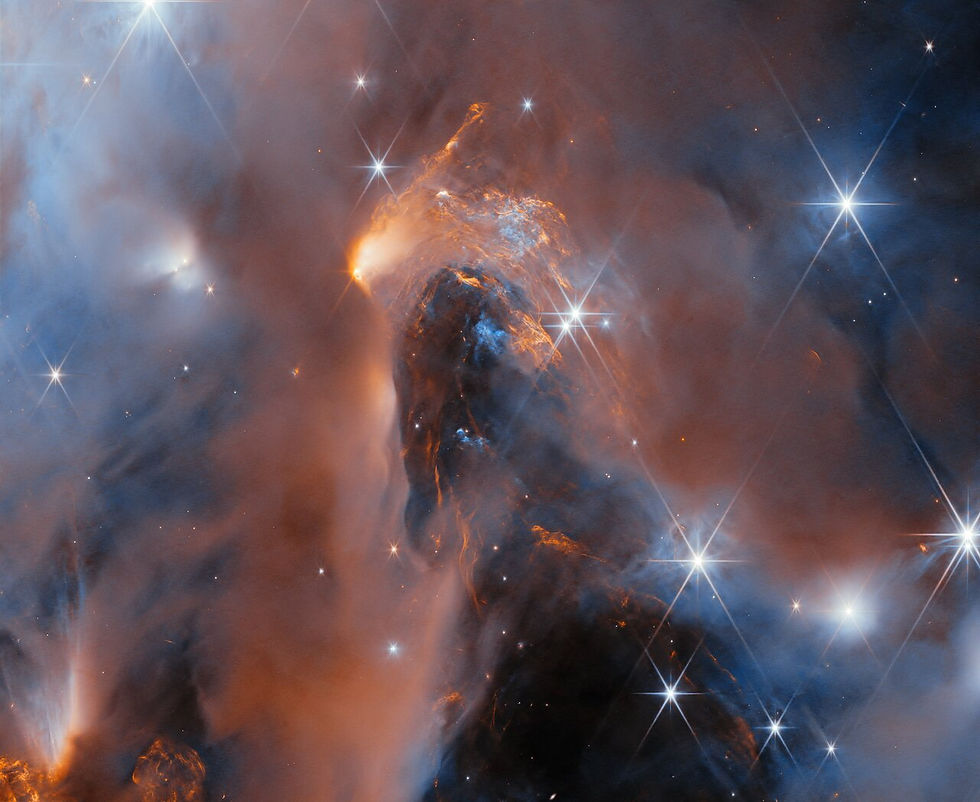
Perseus molecular cloud.
Credit: ESA/Webb, NASA & CSA, A. Scholz, K. Muzic, A. Langeveld, R. Jayawardhana
Another stunner by the current most powerful (and expensive) telescope in the world, the Webb telescope recently snapped this image of a young star nursery, at the edge of a large molecular cloud called Perseus. In this dusty cloud, young stars are forming and feeding off abundant gas and dust. Brown dwarfs, a sort of crossover between cool, small 'failed' stars and hot giant planets have been found in this region. Even more intriguingly, free floating planets, not tethered to a life of orbiting their host stars in circles, can be found drifting serenely through space here too. The orange parts of the image show gas glowing in infrared, caused by ionised material ejected from energetic young stars smashing into the gas of surrounding clouds and heating them up. Glowing regions of ionised gas in infrared are a key indictator of a site hosting young star formation. Our Solar System and Sun would have formed in a similar sort of environment to this, about 4.6 billion years ago. By contrast, the cluster in this image is only about 3 million years old, so gives astronomers an opportunity to study stellar and planetary systems in their nascent stages. In some ways, astronomy is the scientist's version of studying ancient history.
An exploded star (or two?)

Cat Eye Nebula.
Processing & Copyright: Rudy Pohl
This image shows the opposite end of stellar evolution, what happens to some stars near their death. This spectacle is caused by a Sun-like star at the end of its life expelling shells of gas outwards, really living up to the saying 'go out with a bang'. When a star reaches the end of its life after running out of fuel to burn, its core collapses and outer layers puff up. The collapsing core gets so hot and dense that helium fusion is kickstarted, producing an enormous outward rush of energy that crashes the star's outer layers into space, forming a nebula. This cycle can repeat, creating an onion-like layer of gas shells, as is the case in this image, where the shells are thought to be caused by regularly spaced ejections around 1500 years apart. However, the patterns are so complex and intricate that they may be the result of not one star but two, in a binary system, a fancy term for two stars orbiting around each other. This image is a composite formed by Hubble telescope observations and X-ray emission captured by the Chandra Observatory. While the previous photo was a window into our Sun's past, this may be its future, but not for another 5 billion years or so. Stars at the end of their lives are extremely hot and their explosions are energetic, so these are captured by high energy, short wavelength telescopes in ultraviolet and X-ray, whereas stars at the beginning of their lives in the cooler interstellar medium and clouds are captured in longer wavelength infrared on account of their lower energy light. Stellar explosions like this are not only beautiful, but vital for our Universe, as they scatter complex chemicals into the interstellar medium, providing fresh material for future generations of stars.
Galaxies like roses

Interacting galaxy pair Arp 273.
Credit: NASA, ESA and the Hubble Heritage Team (STScI/AURA)
A battle of giants, these two spiral galaxies are engaged in a very drawn out tug of war due to violent gravitational interaction. The blue parts of the image show regions of bright hot stars formed recently, while the inner parts of the upper galaxy are redder, showing older, cooler stars. Spiral galaxies have different compositions within them, as their central bulges contain older stars, little gas (having been mostly used up by stars when they formed), no new star formation, and a metal poor environment, astronomer-speak for having few elements other than hydrogen and traces of helium. By contrast, the arms of galaxy spirals generally contain an abundance of fresh gas, active sites of star formation and bright young stars. Collisions between galaxies, particularly for those of similar sizes, can result in fireworks of star formation, as gas is thrown about and becomes dense and hot enough for new stars to form.
So there we have it, a brief overview of some of the wonderful photos on NASA's immense archive.


Comments