Safari in South Africa
- Apr 26, 2025
- 7 min read
Updated: Apr 27, 2025
Life elsewhere in the universe is all very well, but life on Earth is pretty special too, so today's post will explore some of the beautiful animals we spotted on a recent trip to South Africa. David Attenborough's wildlife documentaries were my main television as a child, being both interesting and unexpectedly educational. I remember spending many rainy afternoons watching his programmes on mammals, marine wildlife, birds, jungles, big cats, plants, meerkats, even insects, staring in awe at the incredible landscapes and marvelling at the evolution of the animals with whom we share a planet. Whether it was predators chasing prey across the savannah, migrating whales and birds, arctic foxes digging in the snow or those bizarre fly-eating plants, I found the experience enriching and thought provoking, much more than any shouty children's television presenter splattered in paint could be. I took my love of nature outside too, which while not as exotic in the suburbs of Cambridge as in Attenborough's jungles, I still enjoyed looking for ladybirds or snails, and was thrilled if I spotted a fox. This year, I was lucky enough to see some of South Africa's most well known animals in the wild for the first time.
The farm we stayed at also included a huge, fenced reserve, where only prey animals lived (so no lions sadly), although there have been rumours of a leopard that managed to sneak in through the fence. A lot of conservation work goes on here, and it was fascinating to see it in practice. The animals are obviously wild, however they are fairly used to being gawped at by astonished tourists, so provided you keep quiet and a respectful distance, they don't bolt immediately. Some of the photos below were taken while I was on horseback, others from a safari vehicle. Big thank you to the ranger Johan and owner Luke, and all their staff, for making this wonderful trip truly special. And now, the wildlife!
Giraffes
Even more striking in real life than photos, giraffes are the tallest terrestrial mammals on Earth, and can be surprisingly well hidden, their heads sometimes popping up above the trees. Their long necks allow them to graze on high leaves and fruits that other herbivores can't reach, although interestingly their proportions change as they age, since it would be difficult for female giraffes to give birth to their young if they had the same neck proportions as adults. Giraffes are herd animals, but mothers temporarily leave the herd to give birth for the safety of their calves, since male giraffes sometimes trample on the newborns. Apparently, the reason for this is so the female comes into season more quickly and the males can mate again! During our weeklong visit, a pregnant female we spotted at the start of the trip had a little calf by the end, which was sweet.
You'd think such a huge animal couldn't run too fast, you'd be mistaken! Their walking is unusual and interesting to watch, as they don't move their legs in opposite diagonals (like a dog or indeed most mammals), but move both left legs forward together, then both right legs. The neck and head provide balance to control the momentum during galloping, which can hit speeds of 60km/h. They can sleep as little as 30 minutes per day, sometimes while standing, as sleeping for long periods of time is dangerous in the wild. Due to their sheer size and uniqueness, these were my favourite animals from the trip.

Zebras
Another South African classic, the zebras we saw galloping through the fields were pretty special, particularly as the sun was setting. It turns out there are several different subspecies, including the maneless zebra and even a brown variety. The ranger Johan told me something fascinating; apparently the white and black stripes on zebras form little convection currents of air which prevents flies from landing on them, since the white stripes reflect heat and the black ones absorb it in alternating strips. As I recall, the zebras in this photo (taken by Nick as it was sharper than mine!) are Burchell's zebras, identified by their shadow like grey stripes between the darker black ones. Another reason for the stripes on zebras is safety, as their stripes are thought to confuse predators, especially when they move in herds. Their stocky bodies reminded me of ponies, but the stripes certainly add a twist to the equine appearance.

Sables
I should've written down the names of all the animals I saw as I couldn't remember all of them, so I've had to look up online which animals I think are in this photo, and following a quick search I believe these are both photos of Sables. In the second one, they were standing very near the track we were driving along, and as we went slowly and quietly, they just stood at us, staring as we stared back. We were probably about 5 metres apart, and it was pretty special.
Apparently rowdy stag-do type gatherings are not just a male human thing, a lot of grasslands grazers do something similar, and Sables are no exception. They usually live in herds of a dozen or so females, led by a single male, as the rest of the juvenile males are exiled into their own herds known as 'bachelor groups', where they spend rather a lot of time fighting each other for females. The most dominant individual emerging from the various fights, which can leave them missing horns or covered in scars, is the first individual to join a new group of females. This all seems rather a lot of effort, and I think chatting up someone in a bar, which might seem nerve wracking at the time, is preferable to a near death experience to find a girlfriend or boyfriend. Perhaps the Sables will discover this eventually.


Two Waterbucks and a Roan antelope
Courtesy of the internet, hopefully these are indeed two Waterbucks and a Roan antelope. One of the things I loved most about the reserve was how all the wildlife coexisted, exhibiting a stunning diversity of animals often grazing alongside each other. While on first glance, it may look like lots of deer type animals with various shapes of antlers/horns, each animal fits into a unique niche of the ecosystem: some live only in the upper hill regions, others only in the bushes, the plains or by certain types of plants. They also adapt to different habitats and diets, which can be seen in something as simple as their feet. I can't recall which exactly, but there was at least one such prey animal which lived in the bushes of the steep mountain sides, and moved almost silently, because it had adapted its walking to place its hind legs in the footprints of its front legs, thereby sneaking into the bushes without so much as a rustle.

Lechwe
I was particularly fond of these beauties, I have been reliably informed they are not Mountain Reedbuck as I first thought, but Lechwe. The males can be identified as the ones with horns, while the females don't have horns, preferring not to fight to near death with each other to sort disputes. Their coats can vary from brown to grey to reddish, and their faces were so striking it looked as though they'd been delicately sprinkled with white powder makeup.


A first time safari photographer, I borrowed this nifty little camera from my mum. I managed to figure out the zoom, contrast and auto focus features, but apart from that I kept it simple. It was much better than faffing around with a dim phone screen scrabbling to photograph some wildlife and dropping your phone from horseback, and I thoroughly enjoyed my first attempt at photography with an actual camera.
We also saw a mongoose or two, diving into burrows as we drove by, and even a flock of ostriches! Unfortunately it was not possible to get close enough to photograph these on horseback, which would've been difficult while we were galloping anyway. I would love to go back to South Africa some time and see more wildlife, it has some truly beautiful wild places.
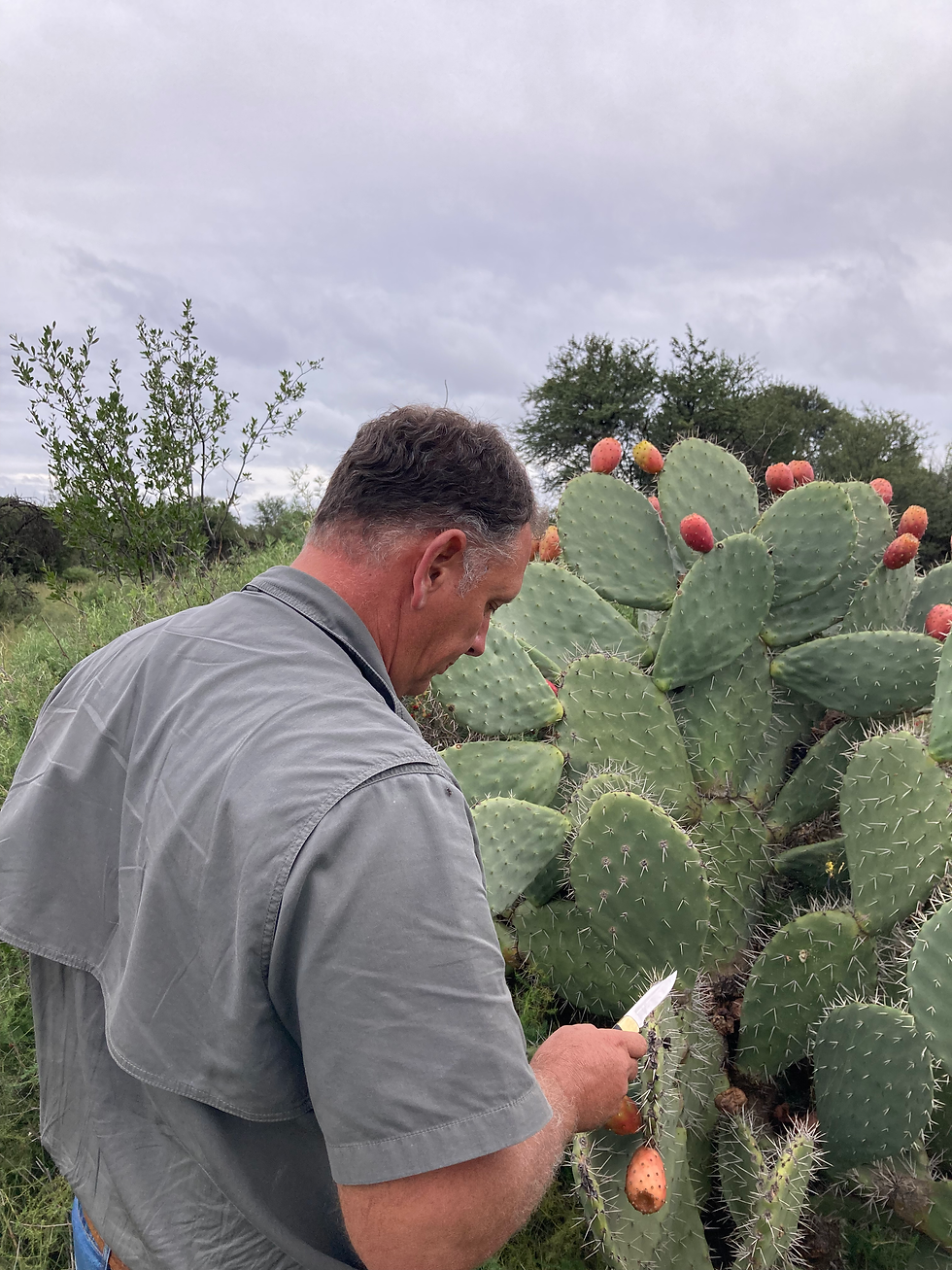
Prickly pears picked fresh
We also enjoyed a prickly pear fresh from a cactus, carefully picked by Johan. The pears are not to be touched by hand, as the hairy bristles are a pain to get out of your clothes or fingers, so Johan used a knife and a stick to hold a pear down and remove its skin, revealing a juicy yellowish fruit beneath. It looked a bit like a mango, and wasn't like anything I'd tasted before, but it was very nice and surprisingly sweet.
South African night sky in the countryside
And finally, an astrophysicist's blog would not be complete without raving about the night sky, where I saw more stars than ever before and even spotted the Milky Way! The disc of our galaxy can be seen as a white, fuzzy belt stretching through the sky, which is the plane of the Milky Way and the fuzziness is caused by a high density of stars in the line of sight. Johan lent me some binoculars, but it was visible with the naked eye too. It is possible to navigate (in the southern hemisphere) using just 4 stars which make the Southern Cross, forming a kite-like shape, and by drawing lines between opposite stars and bisecting them, you can work out which way points southwards.

Alternatively, another way to navigate is using the sound of a generator whirring in the distance to work out where you're going, if like Johan, you find yourself wandering around in the South African bush one night with hyenas lurking, although I can't imagine that is likely to be a regular occurrence for most people!
All in all, it was an incredible adventure, learning so much about the wildlife, environment and cultural history of a different country. Big thank you to everyone at Sparta Polo Club for making this an unforgettable trip.


Wonderful article! Seeing stars of the Southern hemisphere must have been inspirational.