We are made of star stuff - a talk by Prof Dame Jocelyn Bell Burnell
- Mar 5
- 7 min read
Today I listened to a talk by Prof Dame Jocelyn Bell Burnell, where she spoke about us all being made of star stuff, hosted by the Cambridge University Women in Physics Society.
Being made of star stuff might sound bizarre, but it is true - the elements needed for life as we know it would not be possible without the stars in the universe. They are not just a pretty decoration of lights in the sky, they are crucial for our existence. How so?
Taking a brief detour into biology - our bodies are full of water, so hydrogen and oxygen bonded together, while our bones contain calcium, and our blood is full of iron. Where did this all come from?
Big Bang, Hydrogen and the early universe
The most accepted theory for the start of the universe is the Big Bang, where the universe officially started about 13bn years ago, with not so much a bang, but more of a pop. An infinitely small point of matter (known as a primordial soup of quarks and gluons) suddenly expanded at a vast rate, cooling as it did so, yet still being extremely hot at billions of degrees. This matter formed the building blocks of atomic nuclei, called protons. A single proton is otherwise known as a hydrogen nucleus. Within the first second of this sudden expansion, the universe was still too hot for these protons to do anything other than crash into eachother, they were too energetic to bond or form nuclei. Between the first second and the first 3 minutes of expansion is the Goldilocks Zone, where the temperature meant protons had enough energy to start forming basic nuclei such as hydrogen, and even helium nuclei if they could match with neutrons, but beyond this 3 minute mark the protons and neutrons were too dispersed for any of these 'marriages' to occur. This process of cooled protons and neutrons binding together to form basic nuclei is called nucleosynthesis. And so, the early universe expanded and cooled, made up of around 3/4 hydrogen and 1/4 helium, a thin gas which we now refer to as the interstellar medium - the stuff between stars, because space isn't really a vacuum, although there weren't any stars back then of course.
Fusion and birth of the first stars
For 0.4 bn years after the Big Bang (400 million yrs), the universe was a dark, foggy place of hydrogen and helium. At some point within this timeframe, the first stars must have been born. Dates on excatky when this happened seem to vary all the time - looking at my old notes form a few years ago I have written down that this was actually 0.8bn years post Big Bang, but newer research seems to bring this number as close as 0.2bn years for the first stars to form. These stars would have been bigger and brighter than those we see today, lighting up the early universe. The process of star formation would have started out on a very small scale - atoms have a tiny amount of mass, and any mass automaicallty has some gravity, however small. Over time, atoms become attracted to each other, forming small clumps of atoms, now with an increased mass, hence stronger gravity, hence attracting more atoms, growing... and repeating the process. Once these clumps are sufficiently huge, they collapse under their own gravity, which ramps up the pressure and temperature in their cores. At around 15 million degrees, fusion is ignited, which is to say, two hydrogen nuclei can fuse together to form a helium nucleus, and release their excess energy as light, which causes light to glow. Stars burn through their fuel in this way, a process which can last millions to billions of years. Through this way, increasingly heavy elements are made, as lighter elements are fused to make heavier ones. Nevertheless, while these heavy elements are now existing in the cores of massive stars towards the end of their lives, they are still locked in. How to get them out?
I have sketched the star formation process below, a diagram made when I was a young undergraduate preparing for my cosmology internship in Cambridge in the summer of 2023.

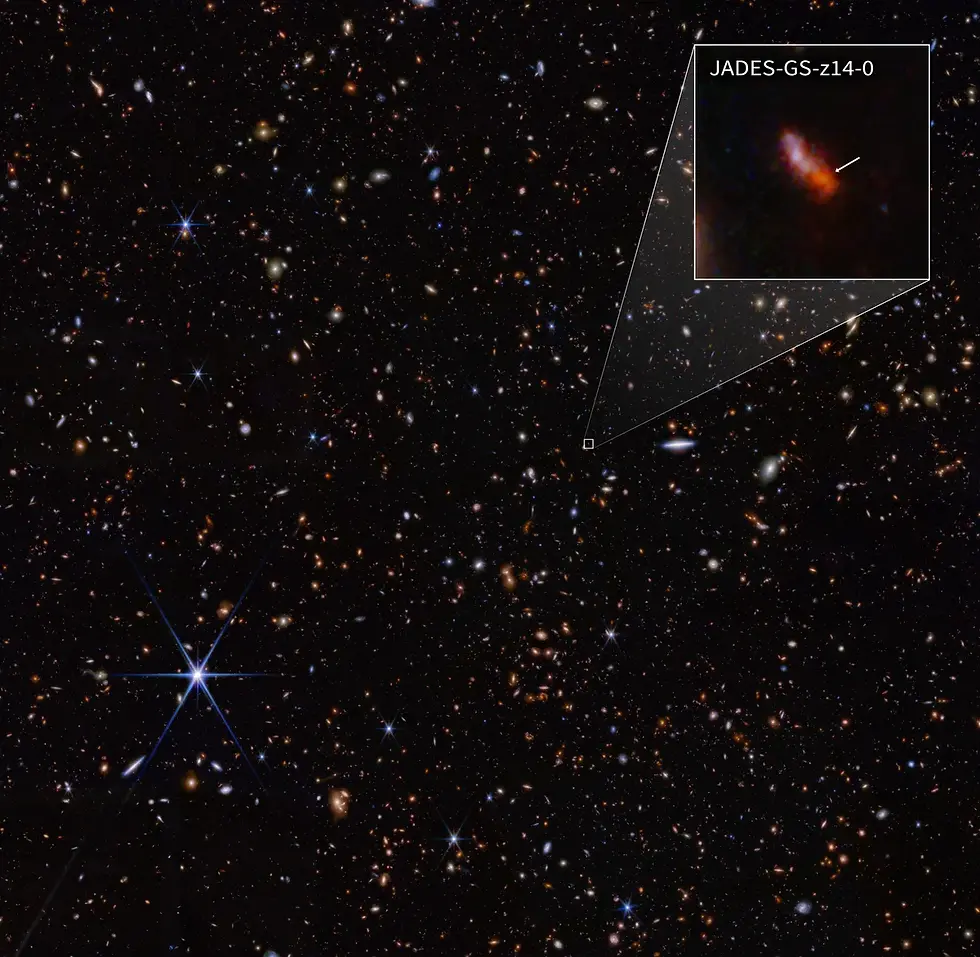
Below, a snapshot from the ever reliable James Webb Space Telescope, peering at a galaxy thought to have existed a mere 0.29bn years after the Big Bang. This galaxy would have been full of massive stars made almost purely of hydrogen.
Supernovae
Stars are held together by the balancing of two forces - the star is prevented from collapsing in on itself by the outward force of radiation pressure, caused by the star burning its fuel, which for some time balances the inwards force of gravity. Fusion continues in the star, with increasingly heavy elements being fused together. As the core is hottest, the heaviest elements are here, and the star appears to have onion like shells of different compositions.

When the fuel for fusion eventually runs out, stars collapse, and then explode as spectacular supernovae. These explosions can be so bright they can outshine a galaxy of millions or more stars. An example of this is shown below, which shows a before and after photo of a nearby satellite galaxy called the Large Magellanic Cloud, where the supernova SN1987A is seen as a huge bright spot, outshining its host galaxy. These explosions can result in supernovae so bright they can even be seen in daytime, as was believed to be the case with the Crab Nebula supernova a thousand years ago, where historical records suggest people were terrified and perplexed by a temporary 'star' that mysteriously appeared in the sky temporarily, even in daytime. Such supernovae typically dim quickly over the course of days to months.

On explosion, these stars scatter their heavy elements like confetti, enriching the interstellar medium and injecting it with metals and other exotic elements. This enriched interstellar medium then forms the basis for building the next generation of stars, this time perhaps slightly enriched by metals recycled from the last stellar generation. It is currently believed that there have been 3 generations (or populations) of stars, so named because our Sun is thought to be a 3rd generation of star, made up of material used in 2 previous stellar generations. Astrophysics takes recycling to a whole new level.
Fascinating as all this is, how does it help us humans? Well, planets are formed in discs of dusty debris around forming stars, so any metallic material in the interstellar medium, or indeed other molecules, can end up in the building blocks of planets, such as the one we call home. An image of one such protoplanetary disc around a star which may have growing planets in it is shown below, which I have written about in more detail in my article from April 2024 "The dust that made us: planets and stars" here.

Prof Dame Jocelyn Bell Burnell and radio pulsars
And now for a little on the fantastic astrophysicist who gave this fascinating talk! She is well known in the world of physics as a phenomal astrophysicist whose career was thrust into the spotlight for a controversy that occured in the 1960s, when she was a young PhD student working on astrophysics at Cambridge. In fact, she went to the same Cambridge college as I did, and it is still an incredible women only environment that celebrates women in science.
During her research, she discovered a type of star called a radio pulsar, a highly magnetised, dense, neutron star which appears to pulse due to its beams which emit radiation at an angle to its poles. The name pulsar is because when these stars rotate, their light beams appear as temporary flashes visible from Earth, much like a lighthouse. Over time, this causes a remarkably regular repeated signal. An illustration of this is shown below.

This discovery in 1967 resulted in a Nobel Prize in 1974, but not for Burnell. While it was her discovery, the male professors who supervised her project scooped up the credit for the most recognised prize in science. This was despite the fact that she had helped build the telescope array to take the data, then analysed the data, made the signal discovery herself, and been told her hypothesis was wrong by these same scientists, when in fact she was right. The decision is still debated and controversial to this day. I hope she does soon get the recognition she deserves by being awarded with this grand prize, albeit several decades too late, not only for her hard work, but for taking the extraordinary lead on such a project when she was a mere graduate student in the face of much more experienced researchers who missed the signals she found.
Nevertheless, she has enjoyed an illustrious career in astrophysics, winning almost every other prize in the field, including the Special Breakthrough Prize in Fundamental Physics in 2018, worth a whopping £2.3 million. And the best part? She donated the entire amount to establish a fund to help female, minority and refugee students to become research physicists. I remember this being announced when I was still a teenager at school, and thinking what a remarkable woman she is. A true trailblazer in the field.



Comments